Showing posts with label hobby. Show all posts

Saturday, July 23, 2011

RCOC Robot Club Values


RCOC Values

Building robots is a fun activity; but for me there are also high ideals that guide my efforts. Helping others to succeed, encouraging experimentation, sharing knowledge, making learning fun, building friendships and inspiring a community of enthusiasts are all desires that focus my passion. Four inter-related disciplines that are foundational for this effort are summed up in the acronym RCOC:


R
Repeatability: this blog exists to serve other robot enthusiasts. That means I will try to refreign from using odd, one-of-a-kind or hard-to-obtain parts. Any person of average intelligence and strong desire should be able to reproduce anything posted here. I will do my best to assist anyone having technical issues.

C
C.O.T.S. (Commercial Off-The-Shelf (products)): robots will be built using generic parts from major vendors where possible (like McMaster Carr, Digi-Key, SparkFun, Pololu, Servo-City). Ideally, each part or a similar one should be available from multiple sources.

O
Open Source: everything is disclosed: electrical, mechanical drawings, source code and parts lists to enrich the community. That also means that everyone is encouraged to contribute to the knowledge base.

C
Competition: to promote creativity and excellence, non-destructive competitions will take place that will cultivate more robust, flexible and effective designs.


If you want to be a part of this community, contact me and join the E-mailing list (and not miss postings).

James the Quack

My other stuff (kayaking, plant ID, sea beans, etc.) [Link]


Robot Motors


A brushed motor without gear reduction is practically useless for robotics. To move things (perform mechanical work) we could use gear-head brush motors, servos or stepping motors (yes, there's others...solenoids, piezo thing-a-ma-jigs, etc.) For locomotion, high-torque and 'horse-power', nothing beats a good gear-head motor. The gear reduction effectively multiplies the torque of the original motor, trading speed for 'umph'. The link below takes you to a matrix of the motors that I have evaluated so far.

Motor Matrix: [Link]

My other stuff (plant ID, kayaking, sea beans, etc.) [Link]

Robot Batteries


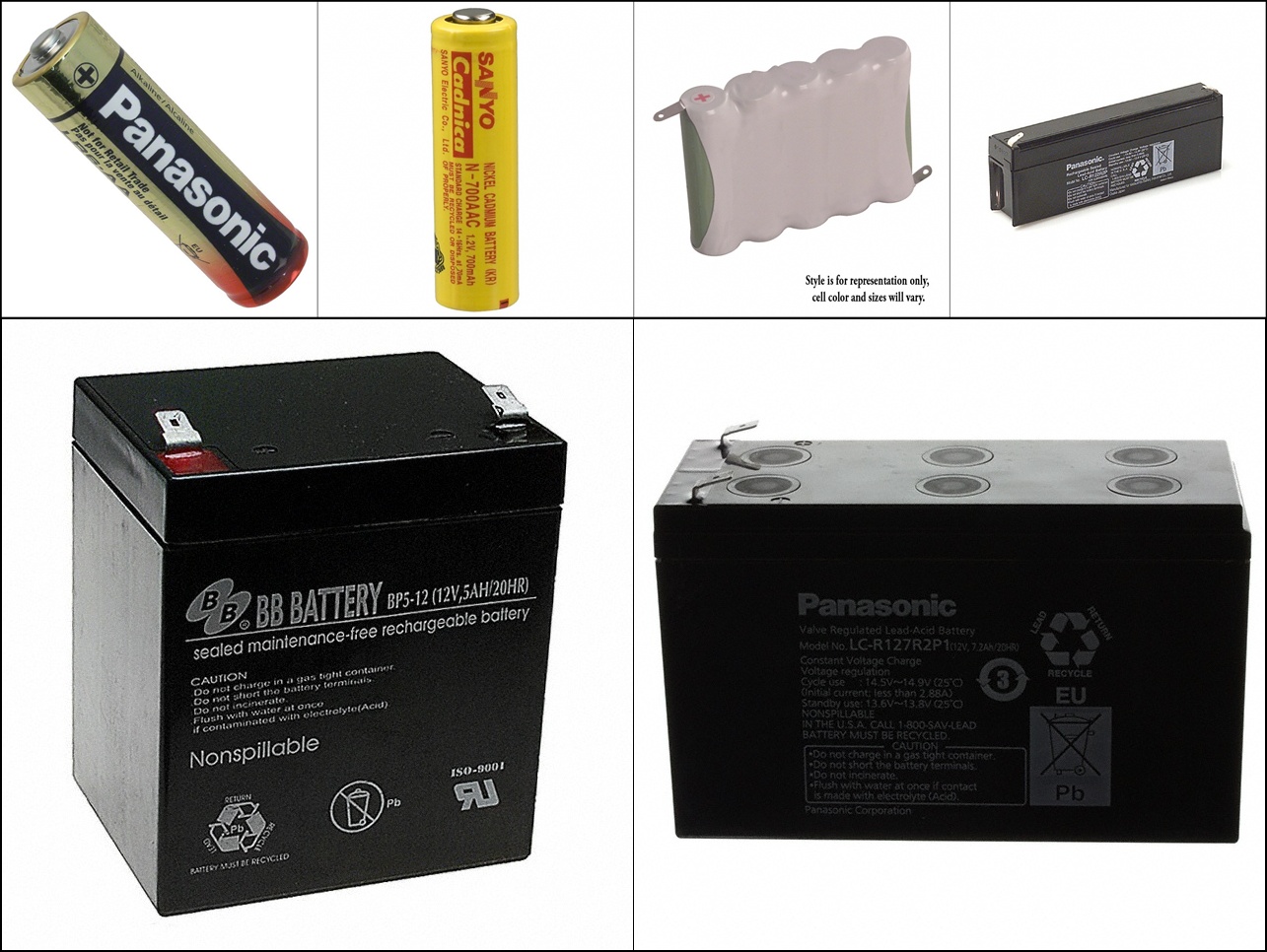
When I was playing with 'Jim-Bob', my toy tank-tread robot, I was appalled by how quickly those little gear motors ate AA batteries! I hate throwing AA alkaline batteries in the trash for so many reasons: environmental, financial and personal thrift. The weight of my first robot, 'Little Jimmy' was nearly 50% gel cell battery. The electric car industry faces similar dilemmas of achieving the needed voltage and capacity at the lowest possible weight and volume (bulk) at a cost people can accept. There are a lot of choices in battery chemistry for secondary (rechargeable) cells: lead acid, gel cells,  nickel cadmium, nickel metal hydride, lithium-ion polymer. They do not come without risk: a few years ago the industry had a rash of exploding lithium lap top batteries. Each type of battery chemistry requires a different charging system. (Batteries in the hands of idiots are dangerous!) Every element of robot design and construction requires research, and batteries are no exception. Attached is a matrix of my research on various battery specs. The conclusions I came up with is that for an Ant-Weight (1 lb) robot like 'Jim-Bob', a 6V NiMH battery pack is a good choice. For a Hobby-Class robot like 'Little Jimmy' (10 lbs) a lead acid gel cell is just fine.


Battery Matrix [Link]


My other interests (Kayaking, plant ID, sea beans, etc. ) [Link]

Monday, July 11, 2011

Comparison of RF Links for Remote Control of Robots


From left to right top row: RC transmitter, RC receiver, XBEE, XBEE Breakout Board
From left to right bottom row: XBEE USB Explorer, Wixel, Nordic, BlueTooth

Comparison (check out all 3 page tabs listed at bottom of spreadsheet) [Link]

Though I have been using an IR (infra-red) remote control for indoor prototype robots, RF is required for good distance and performance outdoors. Due to outrageous Chinese exports, the cheapest and easiest system to implement is the conventional RC (radio control) using PWM signals. Any of the other 2.4GHz link modules will require more smarts in the robot to process the commands, and either a computer or an elaborate self-made transmitter control box. The one big advantage of using these RF module links is that they are transceivers (i.e. they both transmit and receive data), so they make telemetry possible (the receiving of sensor and status signals form the robot.)

James
My main blog list : [Link]

Saturday, July 9, 2011

Monday, June 20, 2011

Robot 1: "Little Jimmy"

Blog's Purpose

It has been a life-long dream of mine to build my own robots; but getting traction on actually assembling one proved difficult. Connecting wheels to motors is not as easy as it looks. Much of what is on the Web either assumed the hobbyist had a large budget, or access to machine shop. Robots can be built with C.O.T.S. (common, over-the-counter stock) if you know what to ask for (or 'Google'). Though I'm an Electronic Technician, there was a lot of mechanical terminology that I was not familiar with. It is my desire in this blog to share what I have learned and help many others succeed in building their own robot. As I build more robots, I intend to publish all circuit designs, drive trains, RC interfacing, battery charging systems and easy programming. I live in an apartment, so I also had to learn to scale down my tools and methods to work in that environment (limited space, noise concerns, thrift) so I will also detail how to work with tools and materials. Not only am I cheap, I'm a little green; recycling and scavenging wire, motors, batteries from any electronics on it's way to a landfill. Feel free to write, share your projects, ask for help.

Why Do I Build Robots?

They are neat! It stimulates my brain. Mechatronics is a synergy of mechanics, electronics, programming, art and science. This keep me studying and learning on myriad disciplines and have loads of fun at the same time.

Survey of Robotics Parts Sources
[Link]

My "Instructables" Blog (Step-by-step instructions)
[Link]

Photo Album of Building Robot 1
[Link]

 Video of "Little Jimmy's" First Steps
[Link]

Robot 1 Parts List
[Link]

Robot 1 Spec Sheet
[Link]

PICAXE Basic Code
[Link]

PICAXE Servo Receiver Motor Controller Circuit
[Link]

My other blogs and stuff (I'm interested in plant identification, nature, kayaking, sea beans, Christianity.......)
[Link]